A falling waterline in July could be the Texas sun doing its work, or a leak quietly draining your pool. Here is how to tell which one you are dealing with.
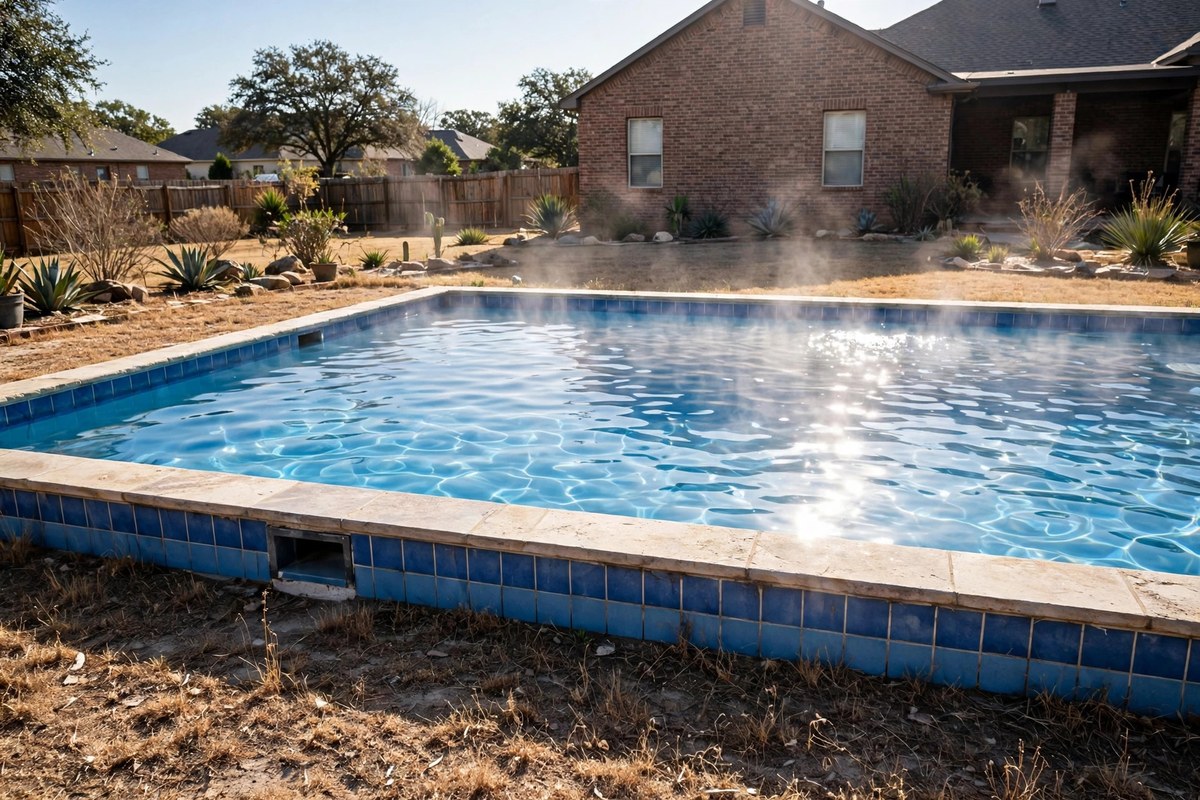
Pool evaporation vs leak is the question that lands in almost every Keller pool owner's mind by mid-July, usually while standing at the skimmer wondering why the tile line looks lower than it did on Monday. The pool was fine in May, the water was clear, nobody swam all week — and yet the level has dropped an inch. In most of the country that would be a clear sign of trouble. In North Texas, it might just be Tuesday.
The reason is the particular combination Keller summers throw at an open pool. Weeks above 100 degrees, humidity that can sit in the thirties, and a steady wind moving across flat, exposed backyards off Rufe Snow Drive and Keller Parkway all pull water off the surface at a rate that surprises people who moved here from cooler states. Add a dark plaster finish that warms the water, a waterfall feature that churns the surface, and a pool that catches full afternoon sun with no shade from the house, and you have a recipe for fast, perfectly innocent water loss.
At the same time, Keller pools genuinely do leak more often than pools in milder climates, and for a reason that has nothing to do with build quality. The expansive clay soil across Tarrant County swells when it rains and shrinks when it dries, and that movement works on buried plumbing joints, skimmer throats, and light niches year after year. So the same backyard can plausibly lose water fast for a completely innocent reason and can also be hiding a real leak behind that fast evaporation. Sorting those two stories out, before you pay for anything, is what this guide is for.
There is no single normal number, because evaporation depends on four things at once: temperature, humidity, wind, and how much of the day the pool sits in direct sun. A sheltered pool behind a fence in the Hidden Lakes area, shaded by mature oaks after three in the afternoon, will lose noticeably less than an exposed pool on a corner lot near Bear Creek Park with nothing to break the wind. That difference alone can be a tenth of an inch a day, which is why comparing your pool with a neighbour's is only a rough guide, never a verdict.
As a working range, an uncovered Keller pool in the heat of summer typically loses between an eighth and a quarter inch per day, with the worst hot, dry, windy stretches pushing toward three-eighths. In spring and autumn, when the air is cooler and more humid, that falls to a sixteenth to an eighth of an inch. In winter, with the pool unheated and the air still, it can be almost nothing for days at a time. If your measured loss sits inside the range for the current weather, evaporation is doing most of the work, and the topping-up hose is just part of summer pool ownership.
The pattern matters as much as the number. Evaporation loss is fairly steady day to day, rising and falling with the weather. A leak, by contrast, often shows up as a rate that does not track the weather at all — the same daily drop on a calm, humid week as on a scorching, windy one, or a drop that suddenly speeds up after months of stability. Keep a simple log for a week or two, noting the level, the weather, and whether anyone swam. That log turns a worry into evidence, and it is the first thing worth having in hand whichever way the answer goes.
Evaporation takes water evenly off the whole surface. A leak usually leaves a fingerprint — something that evaporation alone cannot explain. None of these signs on its own proves a leak, but two or three together, especially when the loss rate ignores the weather, are worth taking seriously.
One sign people often miss is the bill. A pool autofill tied into the house supply can quietly add hundreds of gallons a week to your water use without you ever picking up a hose, and that shows up on the water bill before it shows up anywhere else. If your usage has climbed without any change in household habits, and the pool level is the only suspect, that is another thread worth pulling. Our guide to why a Keller water bill suddenly jumps walks through the boring causes to rule out first, so a pool problem does not get blamed for a running toilet — or the other way round.
The cheapest test is still the bucket test, and it works precisely because it removes the guesswork about the weather. A bucket of pool water sitting on a step inside the pool experiences the same sun, wind, and humidity as the pool itself, so it should evaporate at roughly the same rate. If the pool drops clearly more than the bucket over 24 hours, the extra water went somewhere other than the air. If both drop by about the same amount, evaporation is your answer. Our step-by-step guide on how to do a bucket test for a pool leak covers the placement details that make or break the result, including why the bucket must sit in the pool rather than on the deck.
A second, simpler test is the pump on-versus-off comparison. Run the bucket test once with the pump on its normal schedule, and if it points to a leak, run it again with the pump off for 24 hours. A pool that keeps losing water with the pump off is usually leaking through the shell or a fitting, while a pool that only loses water while the pump runs is more likely leaking in the pressurized plumbing. Keep the level at least halfway up the skimmer mouth throughout, so the pump never sucks air while you are testing.
For a suspected fitting leak, there is also the dye test, which is exactly what it sounds like: with the pump off and the water still, squirt a little food colouring or pool dye near a suspect skimmer throat, light niche, or return fitting and watch whether the dye gets drawn into a crack or gap. It only works on still water and only on leaks you can actually reach, so it will not find an underground pipe break — but it can confirm a skimmer gasket or light seal in about five minutes, and it costs almost nothing. If none of these tests point anywhere, yet the level keeps falling, the leak is most likely underground, and that is where professional equipment earns its keep.
A positive test is the starting point, not the finish line. The next question is where the water is going, and the answer decides what kind of work follows. A leak at a fitting or a skimmer seal is a contained job. A leak in buried plumbing, or one caused by soil movement behind the shell, is a different matter, and it is worth knowing which you are dealing with before anyone starts digging. Watching where the level stops falling, as described above, is the cheapest clue you have, and it is worth a few days of observation.
That is the point where a professional pool leak detection visit makes sense: pressure testing each line separately, dye testing the fittings you cannot easily reach, and listening for water escaping underground can narrow a break down to a few feet without tearing up the deck. Going in with your bucket-test numbers, your pump on-versus-off comparison, and your level log means the search starts from evidence instead of from scratch. If the problem turns out to be on the house side rather than the pool — a supply line feeding an outdoor spigot, for instance — a water leak detection check can rule that out before pool work begins, and for the full picture of what a falling waterline can mean, our guide on a pool losing water with no visible leak walks through the usual hiding places.
And if the tests point the other way — if the bucket and the pool drop together, and the loss tracks the weather — then the honest answer is that your pool is fine and Texas is doing what Texas does. A cover for the hottest weeks, running water features a little less on windy days, and topping up on a schedule rather than in a panic will keep the level steady. Either way, you will have decided from a measurement rather than a worry, which is a better place to be than standing at the skimmer guessing. For a broader reminder of how small, hidden leaks add up across a whole home, the U.S. Environmental Protection Agency's Fix a Leak Week guidance is worth a read.
On a hot, windy week in July or August, a quarter inch a day is not unusual for an uncovered Keller pool, and on the worst days — over 100 degrees, low humidity, a steady breeze across an exposed backyard — it can push toward three-eighths of an inch. That adds up to roughly two inches a week, which looks alarming on the tile line but is entirely weather. The number drops sharply in cooler, more humid weather: in October or March, a sixteenth to an eighth of an inch a day is more typical. If your loss is steady at the summer rate while the weather is mild, or it stays high even when you cover the pool overnight, evaporation is no longer the likely explanation.
Yes, a cover is one of the most effective evaporation controls there is — it blocks wind across the surface and traps humid air just above the water, which can cut daily loss dramatically. That also makes it a useful diagnostic tool: if you cover the pool for several nights and the level still drops at the same rate, the water is almost certainly going somewhere other than the air. Just remember that a cover changes the test conditions, so compare covered nights with covered nights, not with open days. And if your pool has an autofill, switch it off during any comparison, or it will quietly replace the lost water and hide the result.
Yes, but do it deliberately rather than on autopilot. Keep the level at least halfway up the skimmer mouth, because a pump that sucks air through an exposed skimmer can be damaged in ways that have nothing to do with your original problem. Mark the level each time you top up and note the date, so you build a record of how fast it falls between fills — that record is far more useful than a vague sense that you seem to be adding water a lot. If the level is falling so fast that it could drop below the skimmer before you can check it again, or you spot a soggy patch, a sinking deck slab, or a crack in the shell, skip the measuring phase and get the pool inspected sooner rather than later.
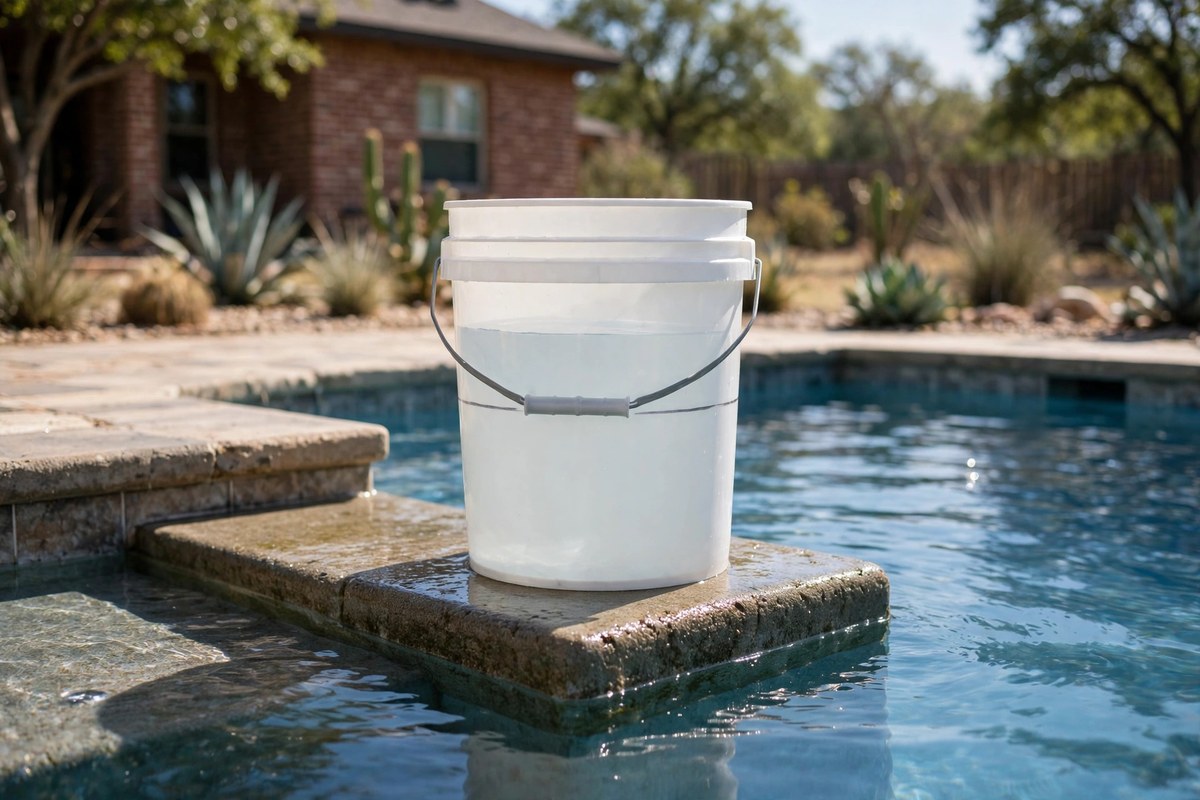
A bucket, a marker, and 24 hours of patience can tell you what a week of topping up cannot: whether your pool is losing water to Texas evaporation or to a leak you need to find.
Read the guide →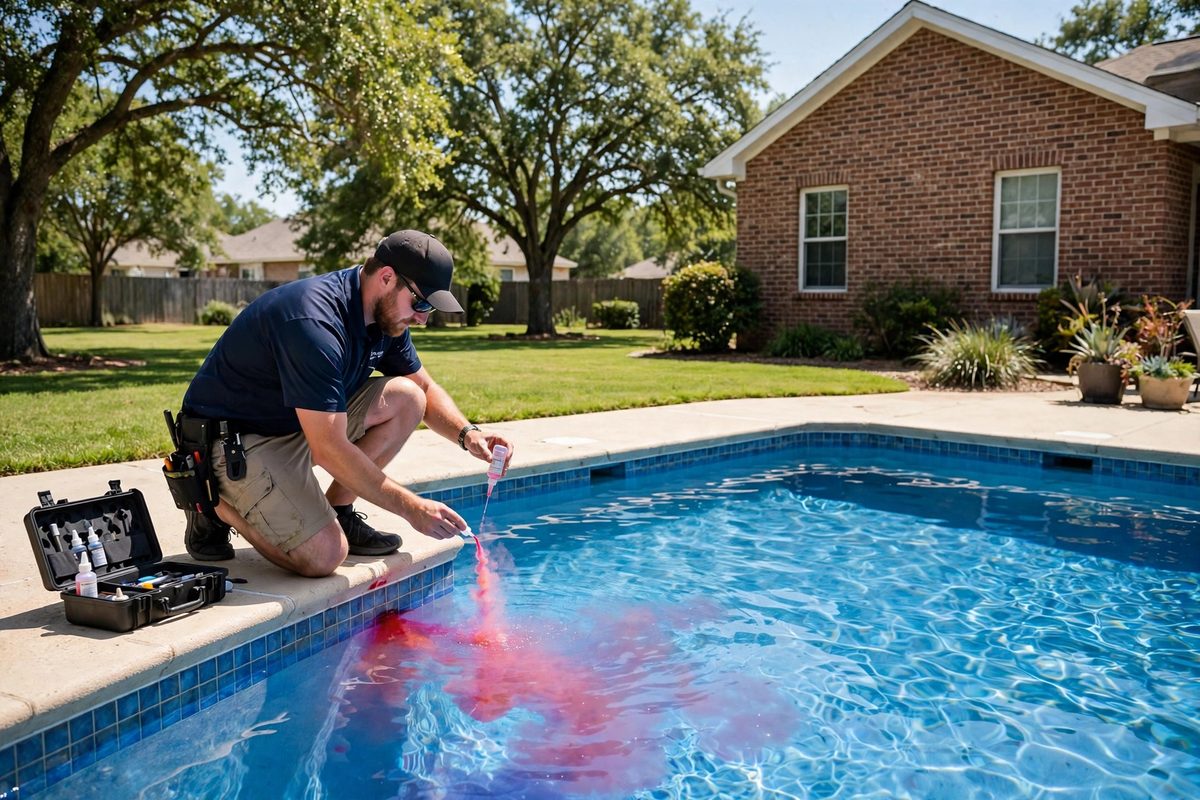
No puddle, no wet spot, but the waterline keeps dropping. In a Keller summer that could be evaporation — or a leak you cannot see yet. Here is how to tell the difference before it gets worse.
Read the guide →Fast response across Keller · Non-invasive equipment · Up-front explanation of your options
